Browse Items (20 total)
Sort by:
Fundamentals of digital image processing
Digital image is a rapidly evolving field with growing applications in science and engineering. Image processing holds the possibility of developing the ultimate machine that could perform the visual function of living beings .

Paradoxes of Media and Information Literacy
Paradoxes of Media and Information Literacy contributes to ongoing conversations about control of knowledge and different ways of knowing. It does so by analysing why media and information literacy (MIL) is proposed as a solution for addressing the current information crisis. Questioning why MIL is commonly believed to wield such power, the book throws into sharp relief several paradoxes that are built into common understandings of such literacies. Haider and Sundin take the reader on a journey across different fields of practice, research and policymaking, including librarianship, information studies, teaching and journalism, media and communication and the educational sciences. The authors also consider national information policy proposals and the recommendations of NGOs or international bodies, such as UNESCO and the OECD. Showing that MIL plays an active role in contemporary controversies, such as those on climate change or vaccination, Haider and Sundin argue that such controversies challenge existing notions of fact and ignorance, trust and doubt, and our understanding of information access and information control. The book thus argues for the need to unpack and understand the contradictions forming around these notions in relation to MIL, rather than attempting to arrive at a single, comprehensive definition. Paradoxes of Media and Information Literacy combines careful analytical and conceptual discussions with an in-depth understanding of information practices and of the contemporary information infrastructure. It is essential reading for scholars and students engaged in library and information studies, media and communication, journalism studies and the educational sciences.
Ethics and Integrity in Multinational Companies
The good news for multinationals is that globalization is creating more universal standards of business conduct, and these are becoming more rigorous. As more companies adopt these standards, it becomes increasingly important for every multinational to establish companywide core values, standards of behavior, and relevant policies in tune with the rest of the world's ethics and compliance environment. The benefits of an ethical culture outweigh the costs. Globally ethical companies will be those that maintain a strong reputation in all their markets, experience increased employee commitment and loyalty, garner advantages in attracting and retaining customers, and generate superior levels of performance and success.
Special article the economic cost and social and psychological impact of musculoskeletal conditions
To provide an indication of the economic, social, and psychological impact of musculoskeletal conditions in the United States. The cost of musculoskeletal conditions was $149.4 billion in 1992, of which 48% was due to direct medical care costs and the remainder was due to indirect costs resulting from wage losses. This amount translates to ˜2.5% of the Gross National Product, a sharp rise since the prior studies, even if part of the increase is an artifact of improved accounting methods. Each year, persons with musculoskeletal conditions make 315 million physician visits, have more than 8 million hospital admissions, and experience ˜1.5 billion days of restricted activity. Approximately 42% of persons with musculoskeletal conditions–more than 17 million in all–are limited in their activities. The economic and social costs of musculoskeletal conditions are substantial. These conditions are responsible for a sizable amount of health care use and disability, and they significantly affect the psychological status of the individuals with the conditions as well as their families.
Choose wisely: making the library’s money work for the library in the system procurement process
Procurement processes for automated library systems need examination to determine if libraries are choosing the best methods for getting the best return on their investment. Understanding the costs involved and how typical decisions in procurement procedures add to the costs of systems will allow libraries to judge if the process better serves the library than using the money in other ways. Alternative processes including standardized request‐for‐proposals, contracts and understanding how to utilize lawyers and consultants are suggested in an attempt to show that procurement processes could achieve the same goals using different methods while allowing libraries to use their money to purchase other goods and/or services. The benefits of the implementation of such processes are also reviewed.
Knowledge management, librarians and information managers: fad or future?
This paper reviews some recent professional and academic publications on aspects of the theory and practice of knowledge management, with particular reference to the curriculum of professional education for library and information management and the career roles and prospects of information professionals. Some commentators dismiss knowledge management as a fad; others view it as a major paradigm shift in the management and exploitation of “intellectual capital”. It is concluded that many aspects of knowledge management practice bear a close resemblance to well‐established practices in librarianship and information management. However, the emphasis by knowledge management theorists and practitioners on the importance of knowledge elicitation and knowledge creation, groupwork and team work, greater involvement in organisational strategy development and support and IT may require greater attention to the personality, motivation and career aspirations of potential entrants to the profession in order to prepare them better for wider‐ranging, multi‐role careers.
Managing Medical Services towards Maximizing Active Healthy Life for a Competitive Economy
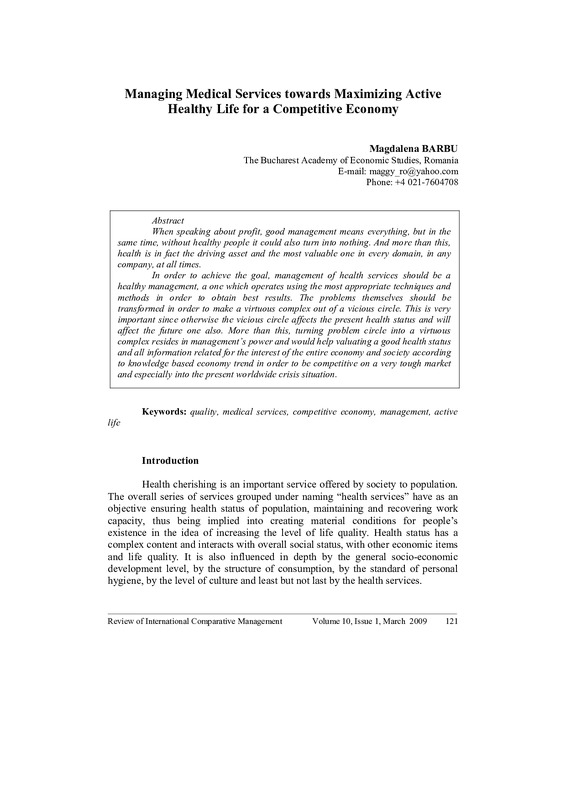
When speaking about profit, good management means everything, but in the same time, without healthy people it could also turn into nothing. And more than this, health is in fact the driving asset and the most valuable one in every domain, in any company, at all times. In order to achieve the goal, management of health services should be a healthy management, a one which operates using the most appropriate techniques and methods in order to obtain best results. The problems themselves should be transformed in order to make a virtuous complex out of a vicious circle. This is very important since otherwise the vicious circle affects the present health status and will affect the future one also. More than this, turning problem circle into a virtuous complex resides in managements power and would help valuating a good health status and all information related for the interest of the entire economy and society according to knowledge based economy trend in order to be competitive on a very tough market and especially into the present worldwide crisis situation.
Semantic Mapping of Bibliographic Models in National
Libraries⋆
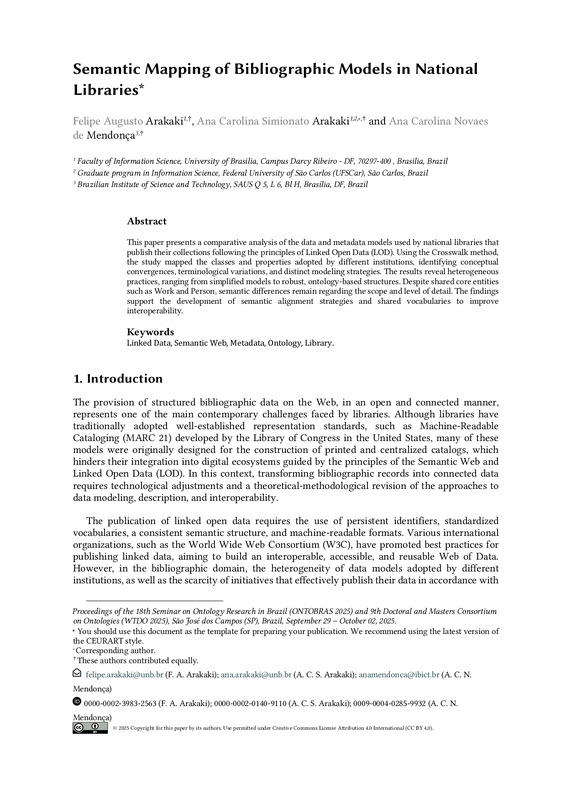
This paper presents a comparative analysis of the data and metadata models used by national libraries that publish their collections following the principles of Linked Open Data (LOD). Using the Crosswalk method, the study mapped the classes and properties adopted by different institutions, identifying conceptual convergences, terminological variations, and distinct modeling strategies. The results reveal heterogeneous practices, ranging from simplified models to robust, ontology-based structures. Despite shared core entities such as Work and Person, semantic differences remain regarding the scope and level of detail. The findings support the development of semantic alignment strategies and shared vocabularies to improve interoperability.
Bibliometrics for Library and Information Science Research of Policy Document
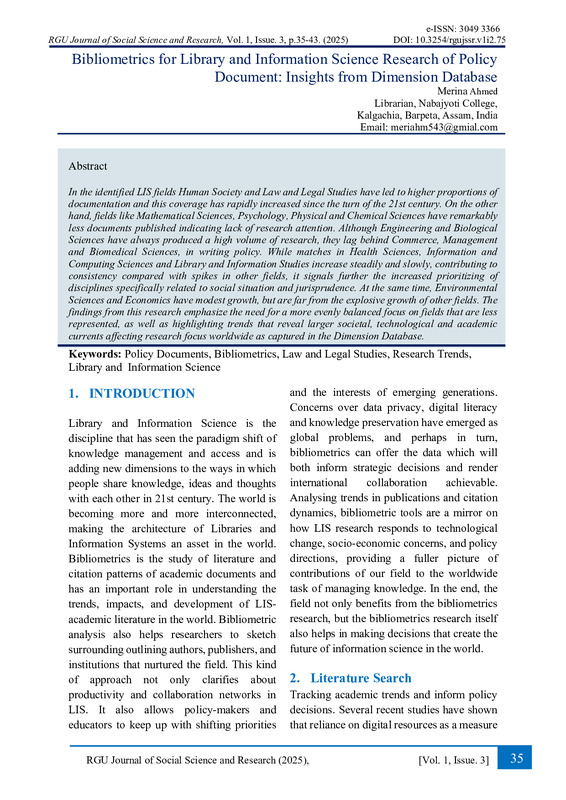
In the identified LIS fields Human Society and Law and Legal Studies have led to higher proportions of documentation and this coverage has rapidly increased since the turn of the 21st century. On the other hand, fields like Mathematical Sciences, Psychology, Physical and Chemical Sciences have remarkably less documents published indicating lack of research attention. Although Engineering and Biological Sciences have always produced a high volume of research, they lag behind Commerce, Management and Biomedical Sciences, in writing policy. While matches in Health Sciences, Information and Computing Sciences and Library and Information Studies increase steadily and slowly, contributing to consistency compared with spikes in other fields, it signals further the increased prioritizing of disciplines specifically related to social situation and jurisprudence. At the same time, Environmental Sciences and Economics have modest growth, but are far from the explosive growth of other fields. The findings from this research emphasize the need for a more evenly balanced focus on fields that are less represented, as well as highlighting trends that reveal larger societal, technological and academic currents affecting research focus worldwide as captured in the Dimension Database.
The unofficial economy and economic development
In developing countries, informal firms (those that are not registered with the government) account
for about half of all economic activity. We consider three broad views of the role of such firms in
economic development. According to the romantic view, these firms would become the engine of
economic growth if not stopped by government regulation. According to the parasite view, informal
firms, by avoiding taxes and regulations, unfairly compete with the more efficient formal firms and,
by taking away their market share, undermine economic progress. According to the dual view, informal
firms are highly inefficient, do not pose much threat to the formal firms, but also do not contribute
to economic growth, which is driven by the efficient formal firms.
Using data from World Bank firm level surveys, we find that informal firms are small and extremely
unproductive, compared even to the small formal firms, and especially relative to the larger formal
firms. Compared to the informal firms, formal ones are run by much better educated managers. As
a consequence, they use more capital, have different customers, market their products, and use more
external finance. Hardly any formal firms had ever operated informally. This evidence is inconsistent
with the romantic and parasite views, but supports the dual view. In this "Walmart" theory of economic
development, growth comes from the creation of the highly productive formal firms. Informal firms
keep millions of people alive, but disappear over time.
for about half of all economic activity. We consider three broad views of the role of such firms in
economic development. According to the romantic view, these firms would become the engine of
economic growth if not stopped by government regulation. According to the parasite view, informal
firms, by avoiding taxes and regulations, unfairly compete with the more efficient formal firms and,
by taking away their market share, undermine economic progress. According to the dual view, informal
firms are highly inefficient, do not pose much threat to the formal firms, but also do not contribute
to economic growth, which is driven by the efficient formal firms.
Using data from World Bank firm level surveys, we find that informal firms are small and extremely
unproductive, compared even to the small formal firms, and especially relative to the larger formal
firms. Compared to the informal firms, formal ones are run by much better educated managers. As
a consequence, they use more capital, have different customers, market their products, and use more
external finance. Hardly any formal firms had ever operated informally. This evidence is inconsistent
with the romantic and parasite views, but supports the dual view. In this "Walmart" theory of economic
development, growth comes from the creation of the highly productive formal firms. Informal firms
keep millions of people alive, but disappear over time.