The unofficial economy and economic development
Dublin Core
Title
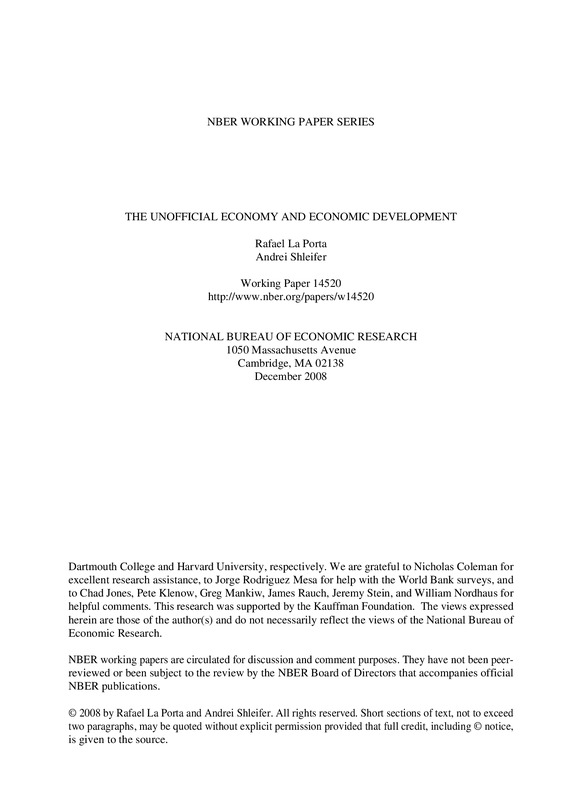
The unofficial economy and economic development
Subject
Economic
Description
In developing countries, informal firms (those that are not registered with the government) account
for about half of all economic activity. We consider three broad views of the role of such firms in
economic development. According to the romantic view, these firms would become the engine of
economic growth if not stopped by government regulation. According to the parasite view, informal
firms, by avoiding taxes and regulations, unfairly compete with the more efficient formal firms and,
by taking away their market share, undermine economic progress. According to the dual view, informal
firms are highly inefficient, do not pose much threat to the formal firms, but also do not contribute
to economic growth, which is driven by the efficient formal firms.
Using data from World Bank firm level surveys, we find that informal firms are small and extremely
unproductive, compared even to the small formal firms, and especially relative to the larger formal
firms. Compared to the informal firms, formal ones are run by much better educated managers. As
a consequence, they use more capital, have different customers, market their products, and use more
external finance. Hardly any formal firms had ever operated informally. This evidence is inconsistent
with the romantic and parasite views, but supports the dual view. In this "Walmart" theory of economic
development, growth comes from the creation of the highly productive formal firms. Informal firms
keep millions of people alive, but disappear over time.
for about half of all economic activity. We consider three broad views of the role of such firms in
economic development. According to the romantic view, these firms would become the engine of
economic growth if not stopped by government regulation. According to the parasite view, informal
firms, by avoiding taxes and regulations, unfairly compete with the more efficient formal firms and,
by taking away their market share, undermine economic progress. According to the dual view, informal
firms are highly inefficient, do not pose much threat to the formal firms, but also do not contribute
to economic growth, which is driven by the efficient formal firms.
Using data from World Bank firm level surveys, we find that informal firms are small and extremely
unproductive, compared even to the small formal firms, and especially relative to the larger formal
firms. Compared to the informal firms, formal ones are run by much better educated managers. As
a consequence, they use more capital, have different customers, market their products, and use more
external finance. Hardly any formal firms had ever operated informally. This evidence is inconsistent
with the romantic and parasite views, but supports the dual view. In this "Walmart" theory of economic
development, growth comes from the creation of the highly productive formal firms. Informal firms
keep millions of people alive, but disappear over time.
Creator
Porta,Rafael La
Shleifer,Andrei
Publisher
NATIONAL BUREAU OF ECONOMIC RESEARCH
Date
2008
Language
English
Type
Article
Identifier
https://www.nber.org/system/files/working_papers/w14520/w14520.pdf
VRA Core
Work Attributes
Title
THE UNOFFICIAL ECONOMY AND ECONOMIC DEVELOPMENT
Files
Collection
Citation
Porta,Rafael La and Shleifer,Andrei , “The unofficial economy and economic development,” Daimari Digital Library , accessed September 9, 2026, https://www.babli-omeka.rguclass.com/items/show/12.
Comments