Browse Items (20 total)
Sort by:
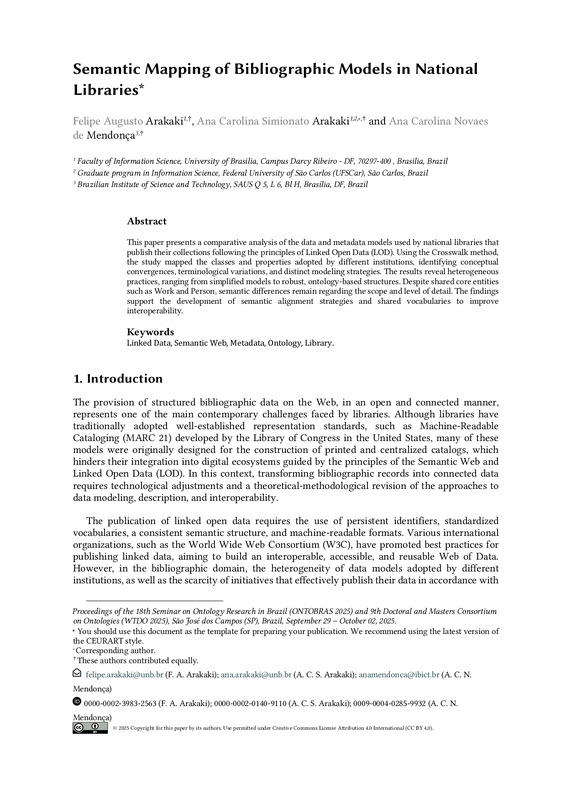
Semantic Mapping of Bibliographic Models in National
Libraries⋆
This paper presents a comparative analysis of the data and metadata models used by national libraries that publish their collections following the principles of Linked Open Data (LOD). Using the Crosswalk method, the study mapped the classes and properties adopted by different institutions, identifying conceptual convergences, terminological variations, and distinct modeling strategies. The results reveal heterogeneous practices, ranging from simplified models to robust, ontology-based structures. Despite shared core entities such as Work and Person, semantic differences remain regarding the scope and level of detail. The findings support the development of semantic alignment strategies and shared vocabularies to improve interoperability.
Special article the economic cost and social and psychological impact of musculoskeletal conditions
To provide an indication of the economic, social, and psychological impact of musculoskeletal conditions in the United States. The cost of musculoskeletal conditions was $149.4 billion in 1992, of which 48% was due to direct medical care costs and the remainder was due to indirect costs resulting from wage losses. This amount translates to ˜2.5% of the Gross National Product, a sharp rise since the prior studies, even if part of the increase is an artifact of improved accounting methods. Each year, persons with musculoskeletal conditions make 315 million physician visits, have more than 8 million hospital admissions, and experience ˜1.5 billion days of restricted activity. Approximately 42% of persons with musculoskeletal conditions–more than 17 million in all–are limited in their activities. The economic and social costs of musculoskeletal conditions are substantial. These conditions are responsible for a sizable amount of health care use and disability, and they significantly affect the psychological status of the individuals with the conditions as well as their families.
Oral Democracy
A talk-centered qualitative analysis of three hundred Indian village assemblies, revealing how the deliberation between citizens in a mass democracy is influenced by state policy and literacy. Essential reading for those interested in participation, development, and deliberative democracy. This title is also available as Open Access.
Fundamentals of digital image processing
Digital image is a rapidly evolving field with growing applications in science and engineering. Image processing holds the possibility of developing the ultimate machine that could perform the visual function of living beings .

The Human Heart for Kids | Educational video to learn all about how the heart works
Do you know why the heart is so important? In The Human Heart for Kids video, you will learn that the heart, apart from pumping blood, also carries lots of other important things throughout the body. The heart is an organ made up mostly of muscle, and it plays a vital role in keeping you and your body healthy and strong.
The human heart is one the most important organs of the body that is essential for survival. It is part of the circulatory system, which is the body system that carries blood and other substances to and from the heart. The other main parts of the circulatory system are blood vessels, which include veins, arteries, and capillaries. And the heart beats automatically because it's controlled by the autonomic nervous system. In 24 hours, your heart averages about 115,000 beats per day!
So how does the heart work exactly? Well, the heart consists of left and right ventricles at the bottom and left and right atriums at the top. Blood pushes through the atriums into the ventricles on each side of the heart through little "gates" every time the heart beats. These gates basically help ensure the blood flows in the right direction. The blood travels through the different vessels throughout the rest of the body. You can think of blood vessels as little train tracks that carry blood to different parts of the body. The trip for a single drop of blood throughout the body takes only about a minute.
Blood carries oxygen, food, minerals, and vitamins as well, and all these things help your body move, grow, and make repairs. In fact, they even help you think! The stuff in your blood that the body doesn't need gets set out as waste through the lungs, kidneys, and liver. To keep your heart healthy, there are a few things you can do. Exercising will help strengthen the muscles of your heart. Eating fruits and vegetables also helps keep your arteries clear. Drinking plenty of water is also essential because water makes up about 83% of the heart. If you don't have enough water, your heart can become less and less healthy. Finally, remember to move around. Moving around helps both your body and your mind.
We hope you and your student(s) enjoyed learning about how your heart works! If you want to learn even more, head over to our website and download one of our many free lesson plans about the heart, full of activities, worksheets, and more!
The human heart is one the most important organs of the body that is essential for survival. It is part of the circulatory system, which is the body system that carries blood and other substances to and from the heart. The other main parts of the circulatory system are blood vessels, which include veins, arteries, and capillaries. And the heart beats automatically because it's controlled by the autonomic nervous system. In 24 hours, your heart averages about 115,000 beats per day!
So how does the heart work exactly? Well, the heart consists of left and right ventricles at the bottom and left and right atriums at the top. Blood pushes through the atriums into the ventricles on each side of the heart through little "gates" every time the heart beats. These gates basically help ensure the blood flows in the right direction. The blood travels through the different vessels throughout the rest of the body. You can think of blood vessels as little train tracks that carry blood to different parts of the body. The trip for a single drop of blood throughout the body takes only about a minute.
Blood carries oxygen, food, minerals, and vitamins as well, and all these things help your body move, grow, and make repairs. In fact, they even help you think! The stuff in your blood that the body doesn't need gets set out as waste through the lungs, kidneys, and liver. To keep your heart healthy, there are a few things you can do. Exercising will help strengthen the muscles of your heart. Eating fruits and vegetables also helps keep your arteries clear. Drinking plenty of water is also essential because water makes up about 83% of the heart. If you don't have enough water, your heart can become less and less healthy. Finally, remember to move around. Moving around helps both your body and your mind.
We hope you and your student(s) enjoyed learning about how your heart works! If you want to learn even more, head over to our website and download one of our many free lesson plans about the heart, full of activities, worksheets, and more!

Paradoxes of Media and Information Literacy
Paradoxes of Media and Information Literacy contributes to ongoing conversations about control of knowledge and different ways of knowing. It does so by analysing why media and information literacy (MIL) is proposed as a solution for addressing the current information crisis. Questioning why MIL is commonly believed to wield such power, the book throws into sharp relief several paradoxes that are built into common understandings of such literacies. Haider and Sundin take the reader on a journey across different fields of practice, research and policymaking, including librarianship, information studies, teaching and journalism, media and communication and the educational sciences. The authors also consider national information policy proposals and the recommendations of NGOs or international bodies, such as UNESCO and the OECD. Showing that MIL plays an active role in contemporary controversies, such as those on climate change or vaccination, Haider and Sundin argue that such controversies challenge existing notions of fact and ignorance, trust and doubt, and our understanding of information access and information control. The book thus argues for the need to unpack and understand the contradictions forming around these notions in relation to MIL, rather than attempting to arrive at a single, comprehensive definition. Paradoxes of Media and Information Literacy combines careful analytical and conceptual discussions with an in-depth understanding of information practices and of the contemporary information infrastructure. It is essential reading for scholars and students engaged in library and information studies, media and communication, journalism studies and the educational sciences.
Information Theory for Data Science
Information theory deals with mathematical laws that govern the flow, representation and transmission of information. The most significant achievement of the field is the invention of digital communication which forms the basis of our daily-life digital products such as smart phones, laptops and any IoT devices. Recently it has also found important roles in a spotlight field that has been revolutionized during the past decades: data science. This book aims at demonstrating modern roles of information theory in a widening array of data science applications. The first and second parts of the book covers the core concepts of information theory: basic concepts on several key notions; and celebrated source and channel coding theorems which concern the fundamental limits of communication. The last part focuses on applications that arise in data science, including social networks, ranking, and machine learning. The book is written as a text for senior undergraduate and graduate students working on Information Theory and Communications, and it should also prove to be a valuable reference for professionals and engineers from these fields.
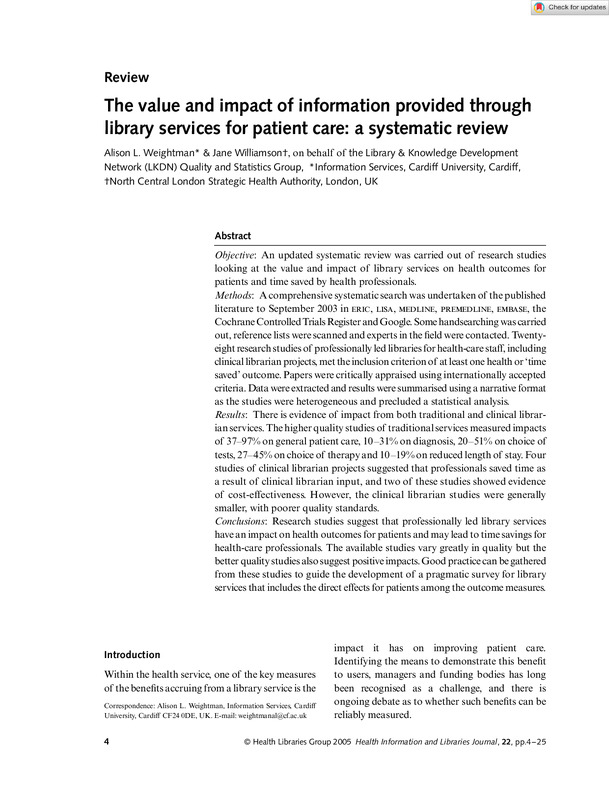
The value and impact of information provided through library services for patient care: a systematic review
Objective: An updated systematic review was carried out of research studieslooking at the value and impact of library services on health outcomes forpatients and time saved by health professionals.Methods: A comprehensive systematic search was undertaken of the publishedliterature to September 2003 in , , , , , theCochrane Controlled Trials Register and Google. Some handsearching was carriedout, reference lists were scanned and experts in the field were contacted. Twenty-eight research studies of professionally led libraries for health-care staff, includingclinical librarian projects, met the inclusion criterion of at least one health or ‘timesaved’ outcome. Papers were critically appraised using internationally acceptedcriteria. Data were extracted and results were summarised using a narrative formatas the studies were heterogeneous and precluded a statistical analysis.Results: There is evidence of impact from both traditional and clinical librar-ian services. The higher quality studies of traditional services measured impactsof 37–97% on general patient care, 10–31% on diagnosis, 20–51% on choice oftests, 27–45% on choice of therapy and 10–19% on reduced length of stay. Fourstudies of clinical librarian projects suggested that professionals saved time asa result of clinical librarian input, and two of these studies showed evidenceof cost-effectiveness. However, the clinical librarian studies were generallysmaller, with poorer quality standards.Conclusions: Research studies suggest that professionally led library serviceshave an impact on health outcomes for patients and may lead to time savings forhealth-care professionals. The available studies vary greatly in quality but thebetter quality studies also suggest positive impacts. Good practice can be gatheredfrom these studies to guide the development of a pragmatic survey for libraryservices that includes the direct effects for patients among the outcome measures.
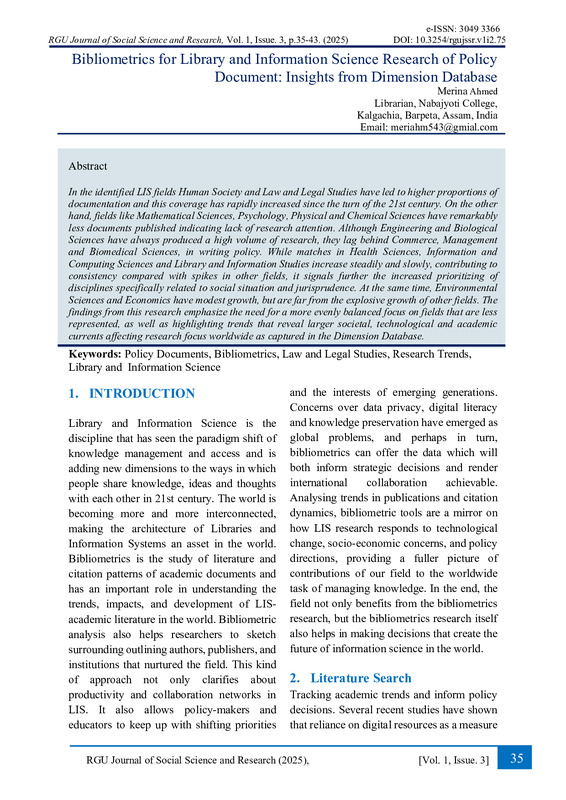
Bibliometrics for Library and Information Science Research of Policy Document
In the identified LIS fields Human Society and Law and Legal Studies have led to higher proportions of documentation and this coverage has rapidly increased since the turn of the 21st century. On the other hand, fields like Mathematical Sciences, Psychology, Physical and Chemical Sciences have remarkably less documents published indicating lack of research attention. Although Engineering and Biological Sciences have always produced a high volume of research, they lag behind Commerce, Management and Biomedical Sciences, in writing policy. While matches in Health Sciences, Information and Computing Sciences and Library and Information Studies increase steadily and slowly, contributing to consistency compared with spikes in other fields, it signals further the increased prioritizing of disciplines specifically related to social situation and jurisprudence. At the same time, Environmental Sciences and Economics have modest growth, but are far from the explosive growth of other fields. The findings from this research emphasize the need for a more evenly balanced focus on fields that are less represented, as well as highlighting trends that reveal larger societal, technological and academic currents affecting research focus worldwide as captured in the Dimension Database.
Koha Library Software: Full Overview & Key Features
Looking for the best Integrated Library Software?
Discover Koha Library Software, the ultimate open-source solution for Smart Library Solutions! Whether you're managing a school, college, or public library, Koha offers a powerful, user-friendly, and cost-effective Library Management System.
In this video, we’ll explore:
00:00 Introduction
00:44 Koha’s powerful features
03:53 Koha: Integration with Standard Protocols
04:59 Popular Integrations
05:26 Why choose Koha?
Why Choose Koha?
Open-source and customizable
Perfect for Schools, Colleges, and Public Libraries
Easy-to-use interface for beginners and professionals
Supports Library Automation and Cataloging
Discover Koha Library Software, the ultimate open-source solution for Smart Library Solutions! Whether you're managing a school, college, or public library, Koha offers a powerful, user-friendly, and cost-effective Library Management System.
In this video, we’ll explore:
00:00 Introduction
00:44 Koha’s powerful features
03:53 Koha: Integration with Standard Protocols
04:59 Popular Integrations
05:26 Why choose Koha?
Why Choose Koha?
Open-source and customizable
Perfect for Schools, Colleges, and Public Libraries
Easy-to-use interface for beginners and professionals
Supports Library Automation and Cataloging