Browse Items (20 total)
Sort by:

Koha Library Software: Full Overview & Key Features
Looking for the best Integrated Library Software?
Discover Koha Library Software, the ultimate open-source solution for Smart Library Solutions! Whether you're managing a school, college, or public library, Koha offers a powerful, user-friendly, and cost-effective Library Management System.
In this video, we’ll explore:
00:00 Introduction
00:44 Koha’s powerful features
03:53 Koha: Integration with Standard Protocols
04:59 Popular Integrations
05:26 Why choose Koha?
Why Choose Koha?
Open-source and customizable
Perfect for Schools, Colleges, and Public Libraries
Easy-to-use interface for beginners and professionals
Supports Library Automation and Cataloging
Discover Koha Library Software, the ultimate open-source solution for Smart Library Solutions! Whether you're managing a school, college, or public library, Koha offers a powerful, user-friendly, and cost-effective Library Management System.
In this video, we’ll explore:
00:00 Introduction
00:44 Koha’s powerful features
03:53 Koha: Integration with Standard Protocols
04:59 Popular Integrations
05:26 Why choose Koha?
Why Choose Koha?
Open-source and customizable
Perfect for Schools, Colleges, and Public Libraries
Easy-to-use interface for beginners and professionals
Supports Library Automation and Cataloging
Knowledge management, librarians and information managers: fad or future?
This paper reviews some recent professional and academic publications on aspects of the theory and practice of knowledge management, with particular reference to the curriculum of professional education for library and information management and the career roles and prospects of information professionals. Some commentators dismiss knowledge management as a fad; others view it as a major paradigm shift in the management and exploitation of “intellectual capital”. It is concluded that many aspects of knowledge management practice bear a close resemblance to well‐established practices in librarianship and information management. However, the emphasis by knowledge management theorists and practitioners on the importance of knowledge elicitation and knowledge creation, groupwork and team work, greater involvement in organisational strategy development and support and IT may require greater attention to the personality, motivation and career aspirations of potential entrants to the profession in order to prepare them better for wider‐ranging, multi‐role careers.

Information Theory for Data Science
Information theory deals with mathematical laws that govern the flow, representation and transmission of information. The most significant achievement of the field is the invention of digital communication which forms the basis of our daily-life digital products such as smart phones, laptops and any IoT devices. Recently it has also found important roles in a spotlight field that has been revolutionized during the past decades: data science. This book aims at demonstrating modern roles of information theory in a widening array of data science applications. The first and second parts of the book covers the core concepts of information theory: basic concepts on several key notions; and celebrated source and channel coding theorems which concern the fundamental limits of communication. The last part focuses on applications that arise in data science, including social networks, ranking, and machine learning. The book is written as a text for senior undergraduate and graduate students working on Information Theory and Communications, and it should also prove to be a valuable reference for professionals and engineers from these fields.
Fundamentals of digital image processing
Digital image is a rapidly evolving field with growing applications in science and engineering. Image processing holds the possibility of developing the ultimate machine that could perform the visual function of living beings .
Ethics and Integrity in Multinational Companies
The good news for multinationals is that globalization is creating more universal standards of business conduct, and these are becoming more rigorous. As more companies adopt these standards, it becomes increasingly important for every multinational to establish companywide core values, standards of behavior, and relevant policies in tune with the rest of the world's ethics and compliance environment. The benefits of an ethical culture outweigh the costs. Globally ethical companies will be those that maintain a strong reputation in all their markets, experience increased employee commitment and loyalty, garner advantages in attracting and retaining customers, and generate superior levels of performance and success.
Choose wisely: making the library’s money work for the library in the system procurement process
Procurement processes for automated library systems need examination to determine if libraries are choosing the best methods for getting the best return on their investment. Understanding the costs involved and how typical decisions in procurement procedures add to the costs of systems will allow libraries to judge if the process better serves the library than using the money in other ways. Alternative processes including standardized request‐for‐proposals, contracts and understanding how to utilize lawyers and consultants are suggested in an attempt to show that procurement processes could achieve the same goals using different methods while allowing libraries to use their money to purchase other goods and/or services. The benefits of the implementation of such processes are also reviewed.
Book cover for Teaching about War in International Contexts: Pedagogical Practices in Secondary Social Studies Classrooms
Buy Print
Teaching about War in International Contexts: Pedagogical Practices in Secondary Social Studies Classrooms
Social studies teachers cannot avoid teaching about war. They must consider how they can teach about war and related topics meaningfully instead of relegating wars to a body of facts, such as dates, places, names, or casualties. Teaching about war helps students comprehend (de)colonization, cultivates their critical thinking skills, and facilitates student understanding of conflict and peace.
In Teaching about War in International Contexts, the contributors adopt the literal meaning of war—a state of armed conflict between nations, states, or groups within a country or state. While there are books out there focusing on how to teach a specific war, such as the Vietnam War or the Korean War, no books highlight the pedagogical practices of teaching global wars. Thus, Teaching about War in International Contexts fills the gap in the existing literature.
This edited book is an invaluable pedagogical resource highlighting the teaching of war in an international context in secondary (grades 6–12 or equivalent) social studies classrooms worldwide. Featuring the voices of classroom teachers, graduate students who used to be classroom teachers, and teacher educators, this book provides readers with classroom-tested practices for teaching about war. Readers will find examples of lesson planning, teaching strategies, teachers’ reflections, and further teaching resources on specific wars. This edited volume is an invaluable resource for secondary social studies classroom teachers, graduate and undergraduate social studies education students, and social studies curriculum and instruction experts.
In Teaching about War in International Contexts, the contributors adopt the literal meaning of war—a state of armed conflict between nations, states, or groups within a country or state. While there are books out there focusing on how to teach a specific war, such as the Vietnam War or the Korean War, no books highlight the pedagogical practices of teaching global wars. Thus, Teaching about War in International Contexts fills the gap in the existing literature.
This edited book is an invaluable pedagogical resource highlighting the teaching of war in an international context in secondary (grades 6–12 or equivalent) social studies classrooms worldwide. Featuring the voices of classroom teachers, graduate students who used to be classroom teachers, and teacher educators, this book provides readers with classroom-tested practices for teaching about war. Readers will find examples of lesson planning, teaching strategies, teachers’ reflections, and further teaching resources on specific wars. This edited volume is an invaluable resource for secondary social studies classroom teachers, graduate and undergraduate social studies education students, and social studies curriculum and instruction experts.
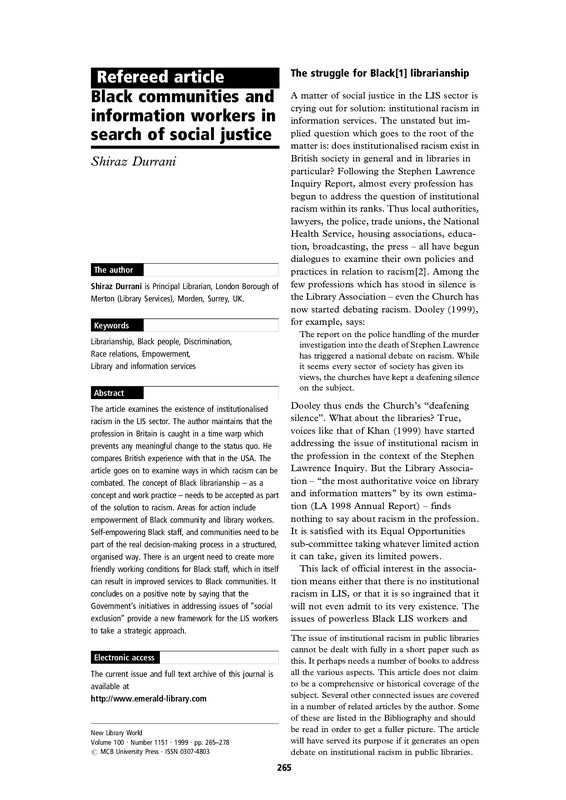
Black communities and information workers in search of social justice
The article examines the existence of institutionalised racism in the LIS sector. The author maintains that the profession in Britain is caught in a time warp which prevents any meaningful change to the status quo. He compares British experience with that in the USA. The article goes on to examine ways in which racism can be combated. The concept of Black librarianship – as a concept and work practice – needs to be accepted as part of the solution to racism. Areas for action include empowerment of Black community and library workers. Self‐empowering Black staff, and communities need to be part of the real decision‐making process in a structured, organised way. There is an urgent need to create more friendly working conditions for Black staff, which in itself can result in improved services to Black communities. It concludes on a positive note by saying that the Government’s initiatives in addressing issues of “social exclusion” provide a new framework for the LIS workers to take a strategic approach.
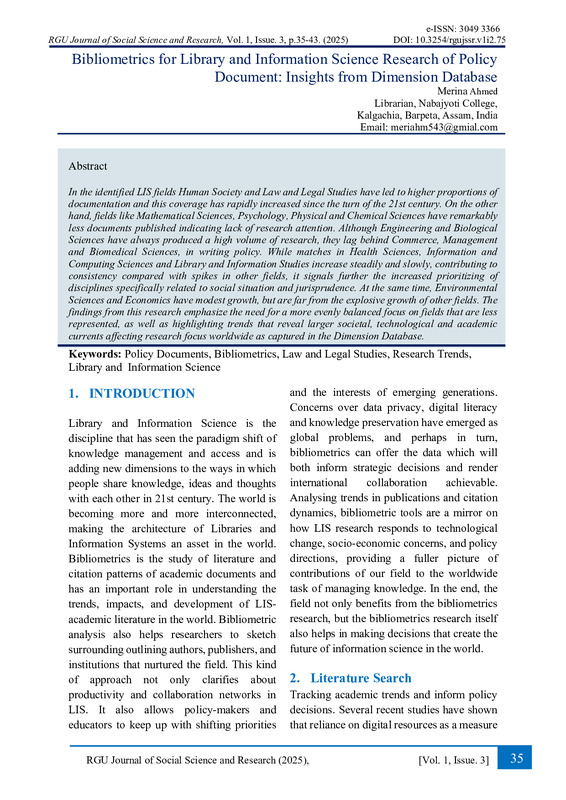
Bibliometrics for Library and Information Science Research of Policy Document
In the identified LIS fields Human Society and Law and Legal Studies have led to higher proportions of documentation and this coverage has rapidly increased since the turn of the 21st century. On the other hand, fields like Mathematical Sciences, Psychology, Physical and Chemical Sciences have remarkably less documents published indicating lack of research attention. Although Engineering and Biological Sciences have always produced a high volume of research, they lag behind Commerce, Management and Biomedical Sciences, in writing policy. While matches in Health Sciences, Information and Computing Sciences and Library and Information Studies increase steadily and slowly, contributing to consistency compared with spikes in other fields, it signals further the increased prioritizing of disciplines specifically related to social situation and jurisprudence. At the same time, Environmental Sciences and Economics have modest growth, but are far from the explosive growth of other fields. The findings from this research emphasize the need for a more evenly balanced focus on fields that are less represented, as well as highlighting trends that reveal larger societal, technological and academic currents affecting research focus worldwide as captured in the Dimension Database.