Browse Items (5 total)
Sort by:
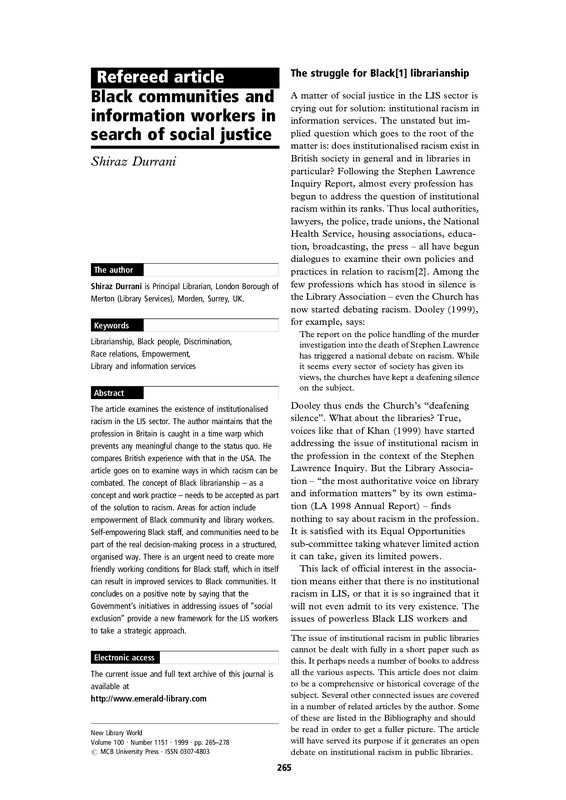
Black communities and information workers in search of social justice
The article examines the existence of institutionalised racism in the LIS sector. The author maintains that the profession in Britain is caught in a time warp which prevents any meaningful change to the status quo. He compares British experience with that in the USA. The article goes on to examine ways in which racism can be combated. The concept of Black librarianship – as a concept and work practice – needs to be accepted as part of the solution to racism. Areas for action include empowerment of Black community and library workers. Self‐empowering Black staff, and communities need to be part of the real decision‐making process in a structured, organised way. There is an urgent need to create more friendly working conditions for Black staff, which in itself can result in improved services to Black communities. It concludes on a positive note by saying that the Government’s initiatives in addressing issues of “social exclusion” provide a new framework for the LIS workers to take a strategic approach.
Knowledge management, librarians and information managers: fad or future?
This paper reviews some recent professional and academic publications on aspects of the theory and practice of knowledge management, with particular reference to the curriculum of professional education for library and information management and the career roles and prospects of information professionals. Some commentators dismiss knowledge management as a fad; others view it as a major paradigm shift in the management and exploitation of “intellectual capital”. It is concluded that many aspects of knowledge management practice bear a close resemblance to well‐established practices in librarianship and information management. However, the emphasis by knowledge management theorists and practitioners on the importance of knowledge elicitation and knowledge creation, groupwork and team work, greater involvement in organisational strategy development and support and IT may require greater attention to the personality, motivation and career aspirations of potential entrants to the profession in order to prepare them better for wider‐ranging, multi‐role careers.
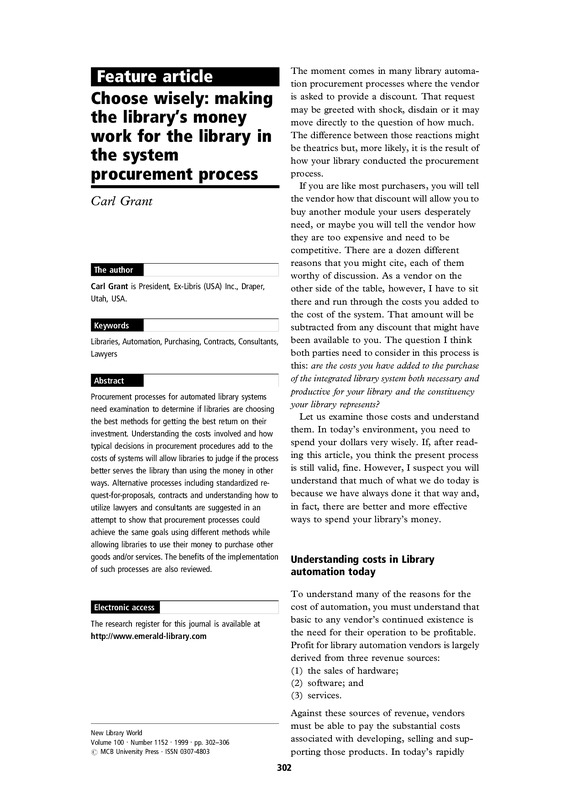
Choose wisely: making the library’s money work for the library in the system procurement process
Procurement processes for automated library systems need examination to determine if libraries are choosing the best methods for getting the best return on their investment. Understanding the costs involved and how typical decisions in procurement procedures add to the costs of systems will allow libraries to judge if the process better serves the library than using the money in other ways. Alternative processes including standardized request‐for‐proposals, contracts and understanding how to utilize lawyers and consultants are suggested in an attempt to show that procurement processes could achieve the same goals using different methods while allowing libraries to use their money to purchase other goods and/or services. The benefits of the implementation of such processes are also reviewed.
Patterns of reading among teenage boys: the reading habits and book preferences of 13‐15‐year‐old boys
What do teenage boys read, and why? Little study has been done specifically of boys′ reading habits, leading to the suspicion that much public library selection for this group has been based on guesswork and intuition. This study sought to fill this gap in our knowledge through 60 one‐to‐one structured interviews of a stratified sample of 13‐15‐year‐old boys, approached through four Essex secondary schools. Discovers that reading compares favourably with other leisure pursuits,most boys reading regularly for 40 minutes per day on average, or one book per fortnight. Selecting fiction by genre, author and series, but chiefly by the blurb, boys are diverse in their tastes. Fifteen‐year‐olds read predominantly adult novels or have effectively ceased reading. The boys read reflectively, and are equally divided between those who imagine the story unfolding in their imaginations,those who imagine their own involvement, and those who do neither. Finds that the use of non‐fiction is lower and less important to teenage boys than had been believed. Draws implications for library provision for this group.
Book cover for Teaching about War in International Contexts: Pedagogical Practices in Secondary Social Studies Classrooms
Buy Print
Teaching about War in International Contexts: Pedagogical Practices in Secondary Social Studies Classrooms
Social studies teachers cannot avoid teaching about war. They must consider how they can teach about war and related topics meaningfully instead of relegating wars to a body of facts, such as dates, places, names, or casualties. Teaching about war helps students comprehend (de)colonization, cultivates their critical thinking skills, and facilitates student understanding of conflict and peace.
In Teaching about War in International Contexts, the contributors adopt the literal meaning of war—a state of armed conflict between nations, states, or groups within a country or state. While there are books out there focusing on how to teach a specific war, such as the Vietnam War or the Korean War, no books highlight the pedagogical practices of teaching global wars. Thus, Teaching about War in International Contexts fills the gap in the existing literature.
This edited book is an invaluable pedagogical resource highlighting the teaching of war in an international context in secondary (grades 6–12 or equivalent) social studies classrooms worldwide. Featuring the voices of classroom teachers, graduate students who used to be classroom teachers, and teacher educators, this book provides readers with classroom-tested practices for teaching about war. Readers will find examples of lesson planning, teaching strategies, teachers’ reflections, and further teaching resources on specific wars. This edited volume is an invaluable resource for secondary social studies classroom teachers, graduate and undergraduate social studies education students, and social studies curriculum and instruction experts.
In Teaching about War in International Contexts, the contributors adopt the literal meaning of war—a state of armed conflict between nations, states, or groups within a country or state. While there are books out there focusing on how to teach a specific war, such as the Vietnam War or the Korean War, no books highlight the pedagogical practices of teaching global wars. Thus, Teaching about War in International Contexts fills the gap in the existing literature.
This edited book is an invaluable pedagogical resource highlighting the teaching of war in an international context in secondary (grades 6–12 or equivalent) social studies classrooms worldwide. Featuring the voices of classroom teachers, graduate students who used to be classroom teachers, and teacher educators, this book provides readers with classroom-tested practices for teaching about war. Readers will find examples of lesson planning, teaching strategies, teachers’ reflections, and further teaching resources on specific wars. This edited volume is an invaluable resource for secondary social studies classroom teachers, graduate and undergraduate social studies education students, and social studies curriculum and instruction experts.